Local Piano Moving
House to house inside Gainesville and the surrounding towns. Two to four movers depending on the instrument and the access at both ends.
- Upright, baby grand and grand
- Blanket wrap and strapping included
- Same-day and next-day slots
Piano Moving Gainesville VA
Uprights, baby grands and grands moved across Gainesville and western Prince William - up three-storey townhomes, out of new-build colonials, between rooms or into storage - by a crew that moves pianos and nothing else.
Gainesville built fast and recently - the typical home here dates from around 2000, and a lot of it is stacked townhomes rather than detached houses. That shapes the work: wide modern doorways, but three storeys of staircase between the garage and the top floor, and a community layout where the nearest place a truck can stand is often not the one outside your door.
What We Do
We move pianos and nothing else. That means the right board, dollies, straps and crew turn up for the instrument you actually own, and that the people carrying it have done this particular job before.
House to house inside Gainesville and the surrounding towns. Two to four movers depending on the instrument and the access at both ends.
Lid locked, legs, lyre and pedals removed, body down onto a padded skid board. Reassembled, leveled and placed where you want it.
Flights, landings, spiral stairs and doorways that look too narrow. We measure first and tell you honestly if a hoist is the safer route.
Out of Virginia or across it, in a truck with air-ride suspension, climate control and the piano strapped upright in its own bay.
Room to room, floor to floor, or out of the way for flooring and decorating. Often an hour's work and far cheaper than a full move.
Between a sale and a move, or during building work. Stored upright on a board, wrapped, in a humidity-controlled unit rather than a dry warehouse.
For an instrument past rebuilding. We take it out of the house without damaging the house, and recycle what can be recycled.
Chancel grands, band-room uprights and stage instruments, moved around a building or between sites, scheduled around services and timetables.
Pianos We Move
Weight is only half of it. An upright is top-heavy and travels on its back edge; a grand has to come apart before it goes anywhere. The crew size, the equipment and the price all follow from which of these is sitting in your room.
Roughly 300 to 450 lb
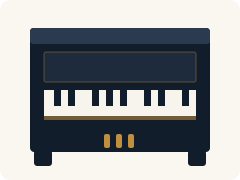
The smallest uprights, common in living rooms and family homes. Short enough to clear most doorways upright, but still far heavier than they look.
Typical crew: Two movers, one piano board
Roughly 450 to 800 lb
Taller cabinets with a longer string length, the type found in schools, churches and practice rooms. Top-heavy, so they are strapped before they move at all.
Typical crew: Two to three movers, board and stair dollies
Roughly 500 to 650 lb
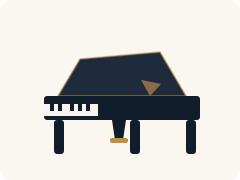
Around 4 ft 6 in to 5 ft 8 in long. Legs, lyre and pedal assembly come off, the body goes onto a padded skid on its straight side, and it is rebuilt in the new room.
Typical crew: Three movers, skid board and dollies
Roughly 650 to 900 lb
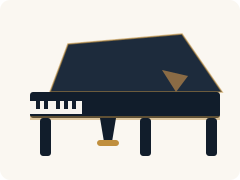
About 5 ft 9 in to 7 ft. Same dismantle, bigger board, and the turning circle becomes the deciding factor on stairs and in hallways.
Typical crew: Three to four movers, long skid
Roughly 900 to 1,300 lb
Over 7 ft, usually in a hall, church or conservatory. Access is surveyed before a date is booked, and a hoist or crane is sometimes the only safe route.
Typical crew: Four movers, survey first
Roughly 150 to 600 lb
Player mechanisms, digital uprights and electronic organs, where the risk is to the action and electronics rather than to the frame. Wrapped and secured the same way.
Typical crew: Two movers, padded crate or wrap
How We Move It
Nothing here is improvised on the day. The questions on the phone decide the crew and the equipment, and the work on site follows the same order whether it is a spinet going across town or a grand coming down two flights.
Make, model, length, both addresses, stairs at each end, doorway widths and where the truck can stand. Those answers are the quote.
We walk the route before we touch the piano. Floors covered, banisters and door frames padded, and the measurements checked against the instrument.
On a grand: lid locked, music desk out, legs, lyre and pedals off and bagged, body eased down onto a padded skid board. Uprights are wrapped whole.
Strapped to the board or skid, then onto dollies for flat ground and stair dollies for flights. The piano is never carried further than it has to be.
Loaded upright against the bulkhead, blanket-wrapped, ratchet-strapped into its own bay so nothing shifts on the road.
Reassembled in the new room, leveled on its casters or cups, and set where you want it. We leave the packing material with us, not with you.
Access and Stairs
Most piano damage happens in doorways and on landings, not on the road. These are the six things we check before a date goes in the book - and the reason we ask for photographs when a route sounds tight.

Local Notes
Modern buildings, modern problems. Nothing here is narrow; plenty of it is tall.
Garage at the bottom, living floor in the middle, bedrooms above - and two flights with a turn at each landing. The piano is nearly always on the middle floor, so there is a staircase in the job either way.
Modern construction gives generous doors and open plans, so the pinch point is almost never a doorway here. It is the landing, and specifically the square metre at the top of the first flight.
In the newer communities the visitor spaces may be a row away from your door. It is a longer carry than people expect in a new neighbourhood, and it is crew time rather than a problem.
Most of these developments are governed, and several want a certificate of insurance naming the association before a commercial vehicle comes in. We issue it in advance.
The Route 29 and Linton Hall junction backs up badly at peak hours and on weekends. Easy to avoid when the move is booked around it.
Cost
A piano move is priced per job, not per hour, and the number is set by the instrument and the route rather than by the mileage. Here is where our work usually lands.
Most jobs sit in a predictable band. A local upright move runs about $250 to $500, a baby grand $450 to $800, and a full grand $600 to $1,500. Stairs, long carries and distance are what move a quote inside those ranges.
| The move | What it usually runs |
|---|---|
| Upright, local, ground floor to ground floor | $250 - $500 |
| Baby grand, local | $450 - $800 |
| Grand or concert grand, local | $600 - $1,500 |
| Each flight of stairs, either end | $40 - $100 |
| In-home move, same floor | $150 - $300 |
| Long-distance, per mile over 100 miles | $2.50 - $6.00 |
| Climate-controlled storage, per month | $60 - $150 |
| Removal and disposal | $200 - $500 |
These are the ranges we work in, not a quote. Where your job lands inside them comes down to the eight factors below. Give us the details and we will price the actual move.
What Moves the Number
Nothing on this list is a surprise charge. They are the questions we ask on the phone, and they are the reason an honest quote cannot be given without them.
| What we ask about | How it moves the quote |
|---|---|
| Type and length of piano | The biggest single factor. A grand needs dismantling, a bigger board and another pair of hands. |
| Stairs at either end | Charged per flight, both addresses. Four flights is a different job from a ground-floor carry. |
| Doorways, turns and thresholds | Tight turns slow the carry and sometimes change the method entirely. |
| Distance between addresses | Local moves are priced as one job. Over about 100 miles it goes to a per-mile rate. |
| Where the truck can stand | A long carry from the curb, a steep drive or a permit zone all add time. |
| Day and timing | Weekends, early starts and out-of-hours access for churches and schools carry a premium. |
| Dismantling needed | Legs, lyre and pedals on a grand; removing a door or a banister where that is the safer route. |
| Storage or a two-stage move | Two handling events instead of one, plus the monthly storage rate while it waits. |
Insurance and Liability
Ask any mover for this in writing before you book, including us. A general carrier's standard liability is often calculated per pound, which on a piano is not the same thing as covering the instrument.
Your piano is covered in transit and during handling, for its value rather than its weight. We will confirm the limit for your instrument when we quote.
Floors, door frames, banisters, walls and lifts at both addresses. This is the cover buildings and property managers ask about.
HOAs, apartment buildings, churches and schools usually want one naming them before they will let a crew in. We issue it on request, before the date.
Why a Specialist
A piano is not heavy furniture. It is a cast-iron frame under about twenty tons of string tension, sitting in a cabinet that marks if you look at it wrong. Here is what actually differs.
| What differs | Specialist piano crew | General moving company | Friends and a rented truck |
|---|---|---|---|
| Equipment | Piano board, skid, stair dollies, ramps | Furniture dollies and straps | Hands and hope |
| Crew trained on pianos | Every job | Sometimes | No |
| Grand dismantle and rebuild | Standard | Rarely offered | No |
| Cover on the instrument | Cargo cover by value | Often liability by weight | None |
| Risk to the piano | Low | Moderate | High |
| Risk to floors, frames and backs | Low | Moderate | High |
| What a mistake costs | Covered | Argued over | Yours |
The cheapest piano move is the one that does not need a repair afterwards. Soundboard cracks, broken legs and a snapped pedal lyre all cost more to put right than the difference between these three columns.
Why Us in Gainesville
A modern townhome is forgiving everywhere except one place. The doors are wide, the plan is open, the hall is clear - and then there is a quarter-turn landing at the top of the first flight that a baby grand will not go round in one piece.
We take the instrument apart at the bottom rather than finding out at the top. Legs, lyre and pedals off, body onto a padded skid, rebuilt and levelled on the floor it is going to.
No deposit taken to quote a job.
Two flights and two landings is the standard job here, not an exception to be worked out on the day.
Standard on every grand and baby grand, which is usually what makes the turn possible at all.
Certificate of insurance naming your association, issued on request and before the date.
Gainesville, Haymarket, Bristow and Manassas locally, out to The Plains, or long distance on an air-ride truck.
Gainesville Questions
How many flights, and where the truck can stand. Those two settle most of a quote here.
(888) 504-9280A local upright move usually runs $250 to $500, a baby grand $450 to $800, and a full grand $600 to $1,500. Moves to Haymarket, Bristow or Manassas sit in the same bands.
In a townhome the flights are what move the number - each one at either end adds to the job.
Usually one up from the garage, and two down from the top floor. It is worth counting rather than describing, because people often call the living level the first floor when it is a flight above the entry.
Tell us the number of flights between the piano and the street and the quote will be right first time.
Yes, but rarely in one piece. It comes apart at the bottom of the flight and goes up on a skid, then is rebuilt and levelled upstairs.
Photograph the landing at the top of the first flight and send it when you call - that is the measurement that decides the method.
Yes. We issue a certificate of insurance naming your association, on request and before the date, at no charge.
Give us the association name when you book so it is in hand rather than chased on the morning.
Yes - Haymarket, Bristow, Manassas, Catharpin, Broad Run, Nokesville, The Plains and Centreville are all normal local work from Gainesville.
Anything further into Fairfax or out to Warrenton is still a single-day job, priced on the distance as well as the route.
Plan on it, though not because of the drive. Each floor of a townhome holds a slightly different temperature and humidity, and that is what shifts the tuning.
Give the instrument two to four weeks on its new floor, then book the tuner.
Regularly. I-66 is minutes away and puts every corridor out of the region within reach.
Long-distance moves go in an air-ride, climate-controlled truck with the piano strapped upright in its own bay and a delivery window rather than a vague week.
One phone call, a few questions about the instrument and the route, and a flat price for the job. Seven days a week.
Service Area
Gainesville is a community of about 16,000 in western Prince William County. These are the places we move pianos to and from most often.